
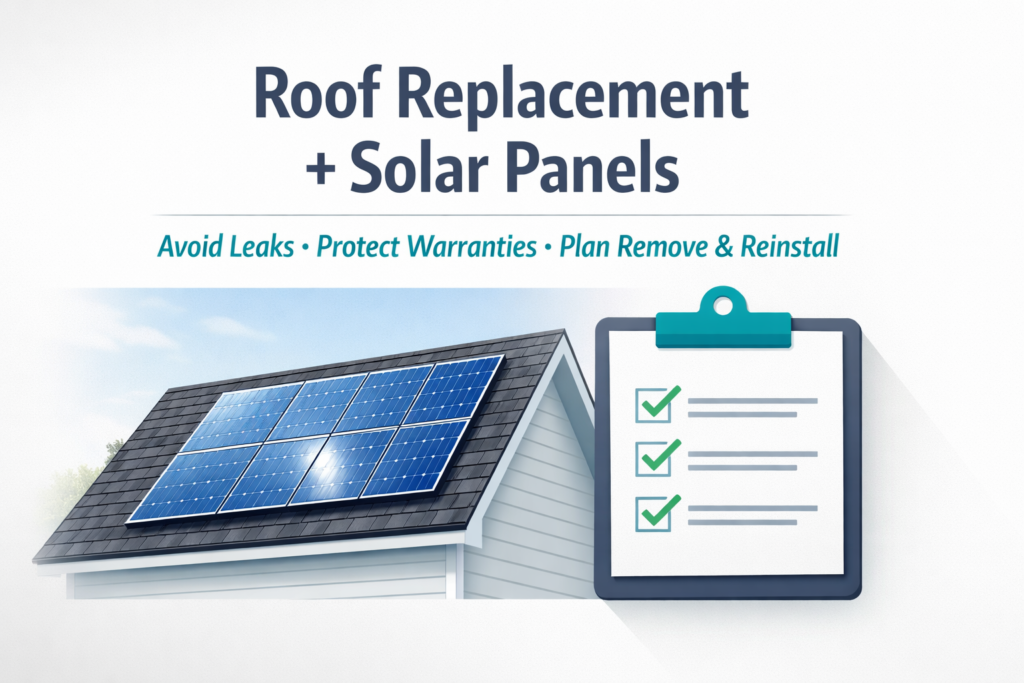
A roof replacement with solar panels isn’t a normal reroof. It’s a coordination project between two systems (roof + solar), and the most expensive problems happen when nobody clearly owns responsibility for penetrations, flashing, and the remove-and-reinstall phase.
If you do this the right way, it’s smooth: new roof, solar back on, warranties protected, and everything documented. If you do it the sloppy way, you can end up paying twice, losing energy production, and stuck in a contractor finger-pointing loop while a leak gets worse.
This is the homeowner checklist that prevents that.
The first decision: should you replace the roof before solar (or before reinstall)?
Here’s the real rule:
If the roof won’t reliably last through the solar system’s intended life, plan the roof first (or bundle it together). Otherwise, you’re almost guaranteeing a future “remove & reinstall” bill.
If you already have solar, you still want a clean plan: remove the array safely, replace the roof properly, then reinstall solar using documented flashing and attachment methods that won’t compromise your roof warranty.
This is where a roof replacement with solar panels goes right or wrong: planning, sequence, and scope clarity.
Remove & Reinstall: the hidden cost people don’t plan for
If solar is already installed and you need a new roof, someone must:
- shut down and disconnect the system safely
- remove panels and racking
- store/handle equipment without damage
- reinstall with correct attachments and flashing
- coordinate any inspections required
Homeowners get burned when the solar company says “we can do it” but the timeline is vague, the price is unclear, and the contract doesn’t state who covers damage during handling.
What to demand before work starts:
- A written “Remove & Reinstall” scope
- Price (fixed or a tight range)
- Timeline (a real window, not “as scheduling allows”)
- Who pays if a panel breaks during removal or reinstall
- Confirmation whether new flashing hardware will be used (often it should)
A roof replacement with solar panels should be scheduled as one coordinated project, not two separate jobs that fight each other.
Leaks don’t come from “bad luck” — they come from penetrations done wrong
Most rooftop solar requires penetrations into structure. Leaks usually come from:
- wrong flashing method for the roof type
- poor integration with underlayment and water-shedding layers
- penetrations placed in vulnerable areas (valleys, transitions, edges)
- “sealant-only” thinking instead of proper flashing
- rushed reinstall after reroof
Hard truth: Caulk is not a waterproofing system. Flashing is.
If you want to avoid the leak blame-game, you need written clarity on who owns the penetration and flashing scope — and you need documentation.
What solar warranties really cover (and what they usually don’t)
This is where homeowners assume protection they don’t actually have.
1) Solar panel manufacturer warranty
Typically covers the panel itself (defects and performance terms).
Usually does not cover roof leaks or installation workmanship.
2) Solar installer workmanship warranty
This is the important one — but only if the contract explicitly includes responsibility for penetrations, flashing, and water intrusion tied to their work.
3) Roofing workmanship/material warranty
Many roof warranties can be compromised by third-party penetrations or unapproved methods.
Bottom line: If your paperwork doesn’t clearly assign responsibility, you can end up with two companies saying “not me.” That’s why the contract language below matters.
This is the part of a roof replacement with solar panels that you don’t want to leave to assumptions.
The contract clauses that protect you (copy/paste)
Use these as a checklist when reviewing proposals.
Leak responsibility (solar penetrations)
“Solar installer is responsible for any roof leaks originating from solar penetrations, mounts, flashing, and related workmanship for ___ years.”
Flashing method + compatibility
“All penetrations shall be flashed using a listed flashing system compatible with the roof covering, installed per manufacturer instructions and per approved plans.”
Documentation requirement
“Installer shall provide dated photos of each penetration and flashing detail prior to final array completion.”
Remove & Reinstall scope + cost
“Remove & reinstall price is $____ and includes disconnect, removal, storage, reinstallation, and inspection coordination if required.”
Warranty survival statement
“Roof warranty remains valid provided penetrations are installed only using approved flashing methods and performed by qualified installer.”
Insurance requirement
“Installer must provide proof of general liability and workers’ comp coverage applicable to water intrusion claims.”
If any contractor refuses to put this in writing, understand what’s happening: they’re trying to keep flexibility while you hold the risk.
Permits, inspections, and scheduling: avoid being stuck between two crews
Most jurisdictions treat reroofing and solar as permitted scopes. The common failure is scheduling:
- roofer finishes → solar company delays → array sits off-roof
- homeowner loses production and gets stuck waiting
- reinstall happens rushed → workmanship suffers → leak risk rises
A professional roof replacement with solar panels includes:
- one coordinated timeline
- clear responsibility for calling inspections
- clear responsibility for corrections if inspection fails
- a plan if weather hits while solar is off
Roof type matters: what changes depending on your roof
Asphalt shingles: flashing must integrate correctly under shingle courses. Avoid mounts too close to valleys and transitions.
Tile roofs: higher breakage risk during removal/reinstall; requires crews experienced with tile handling and replacement planning.
Metal roofs: clamp systems may reduce penetrations on standing seam; incorrect attachment methods can create leak pathways.
The “same solar system” installed on different roof types can have very different leak risk. That’s why roof-specific mounting and flashing details matter.
For investors and landlords: protect resale and reduce insurance friction
For rentals and flips, solar can be a win — but only if it doesn’t create future maintenance disputes or underwriting headaches. Investor-grade moves:
- replace the roof first when remaining life is low
- document permits, photos, and product specs
- assign penetration/leak responsibility in writing
- avoid cheap reinstall shortcuts
If you’re planning upgrades for resale or long-term hold strategy, use a structured ROI approach through JReyes Investments:
https://jreyesinvestments.com
When a GC coordination layer saves you time and protects the scope
Roof + solar projects often involve multiple trades, permit timing, inspection sequencing, and tight scheduling. If you don’t want to act as the project manager (and be the one getting blamed), GC coordination can prevent “not my job” chaos.
For construction management and permit coordination support, see TOLT Construction:
https://toltcgc.com
Final checklist (save this)
Before you approve a roof replacement with solar panels, confirm you have:
- Roof remaining-life assessment (not a sales opinion)
- Written remove & reinstall scope and pricing (if solar exists)
- Mounting + flashing system named (brand/model)
- Penetration/leak responsibility clause assigned in writing
- Photo documentation requirement for penetrations
- Permit/inspection plan and a real schedule
Done right, this project is predictable. Done wrong, it becomes expensive drama.