
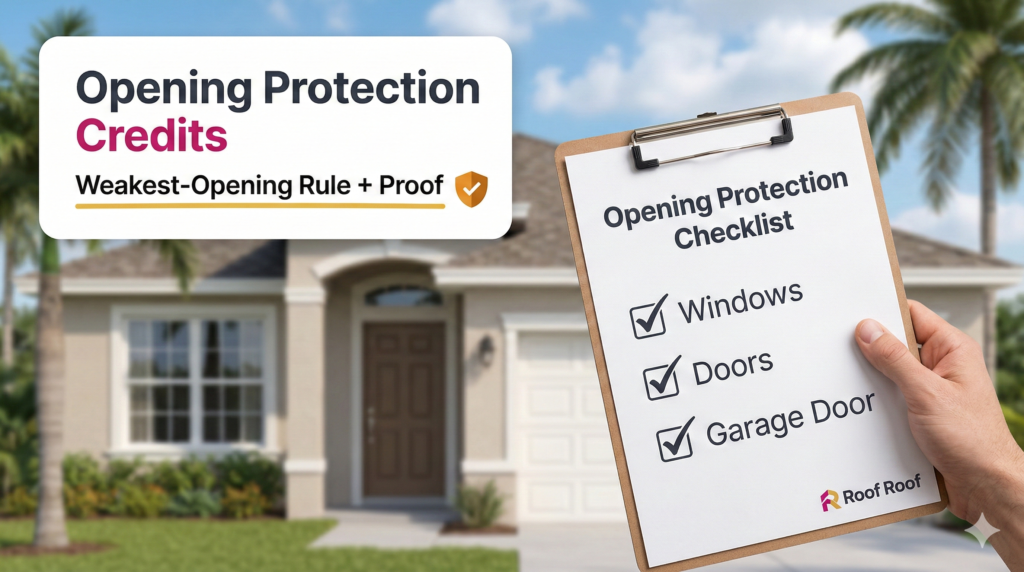
Opening Protection Wind Mitigation: The Weakest-Opening Rule (and How to Document It So Credits Don’t Disappear)
Opening protection wind mitigation credits can lower the wind portion of your homeowners insurance—until underwriting reviews the file and downgrades it. The reason is brutally simple: opening protection is not “most openings.” It’s every opening—and the category is often determined by the weakest opening on the home.
That means one unprotected window, one door without proof, or one garage door without a rating label can drag the entire opening-protection credit down.
If you want your credits to stick, this is a documentation game: permits, product approvals, labels, and photos that prove what’s installed.
External resources (DoFollow):
- OIR-B1-1802 form (PDF): https://floir.gov/docs-sf/default-source/property-and-casualty/oir-b1-1802.pdf
- Citizens feature documentation guidelines (PDF): https://www.citizensfla.com/documents/20702/31330/Wind%2BMitigation%2BFeature%2BDocumentation%2BGuidelines/95ad04f0-7e78-4fa1-b745-73ae01e409ac
- Florida CFO guide on mitigation discounts: https://www.myfloridacfo.com/docs-sf/consumer-services-libraries/consumerservices-documents/understanding-coverage/consumer-guides/premium-discounts-for-hurricane-loss-mitigation.pdf
What “opening protection” means (in plain English)
On the OIR form, “opening protection” generally refers to whether your home’s openings (windows, exterior doors, garage doors, skylights, and certain glazed openings) are protected with systems rated for wind-borne debris and/or meet approved protection standards.
Key point: The form and underwriting logic typically evaluate the home by the weakest protection condition present. If one opening is not protected or not documented, you can lose the better classification.
This is why opening protection wind mitigation is one of the most downgraded categories.
Common ways people lose opening protection credits
- They have impact windows but no permit and no proof of ratings
- They have shutters but no product approval documentation
- They upgraded the front door but forgot the garage door
- They assume “a few unprotected windows don’t matter”
- The inspector can’t photograph labels/markings that prove compliance
9 critical proof steps to keep your opening protection credits
1) Inventory every opening (yes, every one)
Make a quick list:
- all windows
- all exterior doors (including side garage service door)
- garage door(s)
- skylights and glass doors
If you don’t inventory, you miss the one weak link that kills your credit.
2) Don’t confuse “hurricane film” with rated protection
Some products reduce shatter, but are not always accepted as opening protection for mitigation credits unless they meet specific approvals/ratings and are installed under an approved system.
Rule of thumb: If you can’t produce documentation showing it’s approved for wind-borne debris, don’t assume it earns credit.
3) Gather permits first (permits beat opinions)
Underwriting trusts a permit trail more than “it was installed in 2021.”
What to collect:
- window/door permit and final inspection
- contractor invoice showing scope + address
- any inspection cards/records you have
4) Product approvals: keep the exact model documentation
You need documentation that matches what’s installed:
- manufacturer
- product line/model
- approval/impact rating documentation (as applicable)
If the paperwork doesn’t match the installed product, underwriting can treat it as unverified.
5) Labels and etching: photograph what proves rating
Inspectors often rely on:
- etched markings on glass
- labels/stickers on frames
- garage door rating labels (sometimes inside the door edge/track area)
Take clear photos:
- one wide shot showing the opening
- one close-up showing the label/etching
6) Garage doors are the silent credit killer
Many homes have impact windows but an older garage door with no verifiable rating. Underwriting can downgrade your opening protection category based on that weakness.
What to document:
- garage door rating label photo (if present)
- permit/invoice if replaced
- manufacturer documentation if available
7) Shutters: document approval + coverage + installation type
Shutters can qualify, but only if:
- approved/ rated as required
- they cover the opening properly
- the documentation supports the product installed
If shutters exist but you can’t prove what they are, underwriting may not give full credit.
8) Build a single PDF “Opening Protection Evidence File”
This is what prevents underwriting downgrades.
Include:
- a one-page opening inventory list
- permits + invoices
- product approvals/specs
- labeled photos (Windows / Doors / Garage Door / Shutters)
Florida CFO guidance emphasizes mitigation discounts depend on verified features supported by documentation/photos.
https://www.myfloridacfo.com/docs-sf/consumer-services-libraries/consumerservices-documents/understanding-coverage/consumer-guides/premium-discounts-for-hurricane-loss-mitigation.pdf
9) If one opening is weak, fix the weak link first
If your goal is opening protection wind mitigation credit, don’t upgrade “randomly.” Upgrade strategically:
- garage door first if it’s the weak link
- then doors/windows without proof
- then add shutters where needed
It’s cheaper to fix the weakest link than to upgrade what’s already qualifying.
Internal links (Roof Roof)
- Roofing services: https://roofccc.com/services/
- Contact: https://roofccc.com/contact/
- More Florida roofing + insurance guides: https://roofccc.com/blog/
Investor note (this affects underwriting + resale)
For rentals and flips, verified opening protection can reduce insurance friction and make the property easier to underwrite and sell. Investor planning:
https://jreyesinvestments.com
GC coordination (multi-trade upgrades)
If you’re coordinating openings + roofing + permits, GC scheduling prevents delays and scope gaps:
https://toltcgc.com
Next step
If you want opening protection credits to stick, stop treating it like “I have impact windows.” Treat it like a proof package. Roof Roof can help you identify the weakest opening, prioritize upgrades, and organize documentation so underwriting doesn’t downgrade your credits.